.png?width=75&height=75&name=Untitled%20design%20(22).png)
📌 Key Benefits
Parameters are designed to make your estimating process simpler and more flexible — saving you time, reducing errors, and helping you adapt quickly when project details change.
-
Eliminate manual recalculations — update a single parameter and watch all linked estimate items adjust automatically.
-
Save valuable time by setting up common measurements once and reusing them across multiple items.
-
Boost accuracy with formulas that instantly reflect real-world changes in your project.
-
Simplify estimating by letting the system handle the math for you.
-
Stay adaptable on-site — quickly update room sizes or dimensions as field conditions change.
Step 1: Locate Parameters in Your Project
-
Navigate to your project’s Estimate page.
-
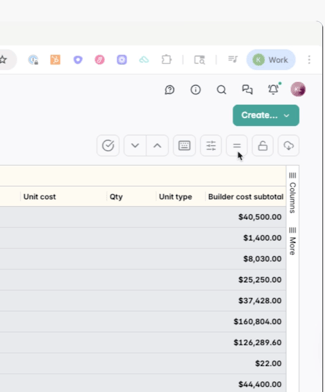
In the upper-right corner, click the equal sign (=) icon to open the Parameters panel.
-
Add your parameter labels (e.g., Living Room, Dining Room, Master Bedroom) and enter their square footage or other measurements.
💡 Pro Tip for Estimators: Set up common room sizes or recurring dimensions at the start of each project to quickly reference them in your formulas.
Step 2: Apply Parameters in an Estimate Item
-
Go to the category where you want to apply a parameter (e.g., Finishes).
-
Select the item you want to calculate (e.g., Hardwood Flooring Materials).
-
In the Quantity column, double click and edit.
-
Build your formula using:
-
Basic math (+, −, ×, ÷)
-
Functions (e.g.,
SUM) -
The parameter labels you set earlier
-
Example: SUM(Living Room, Dining Room, Master Bedroom)
🎓 You can bulk importing or update estimate parameters from a CSV. To learn more and get a step-by-step explanation, read "How to bulk import or update estimate parameters from a CSV."
Supported Parameter Functions Ressio
Use these functions anywhere formulas are supported in estimate item quantities.
| Name | Type | Symbol/ Function |
Description | Example | What it Returns |
| Add / Plus | Operator | + |
Adds values together | Living Room + Dining Room |
Combined total |
| Subtract / Minus | Operator | - |
Subtracts one value from another | Total Area - Hallway |
Difference between values |
| Multiply | Operator | x or * |
Multiplies values | Length x Width or Length * Width | Area or total quantity |
| Divide | Operator | ÷ or / |
Divides one value by another | Total SF ÷ 4 or Total / 4 |
Value split into equal parts |
| SUM | Function | SUM () |
Adds two or more values or parameters | SUM (Room1, Room2, Room3) |
Combined total |
| PRODUCT | Function | PRODUCT () |
Multiplies two or more values | PRODUCT ( Length, Width) |
Area, volume, or mass total |
| ROUNDUP | Function | ROUNDUP () |
Rounds a value up to the next whole number | ROUNDUP (SQFT) |
9.1 ->10 |
| ROUNDDOWN | Function | ROUNDDOWN () |
Rounds a value down to the nearest whole number | ROUNDDOWN (SQFT) |
9.9 ->9 |
| CEILING | Function | CEILING () |
Rounds up to the nearest multiple you specify | CEILING(SF, 50) |
121->150 |
| FLOOR | Function | FLOOR() |
Rounds down to the nearest multiple | FLOOR (SF, 10) |
127->120 |
| SQRT | Function | SQRT() |
Returns the square root of a value | SQRT(Area) |
Square root value |
💡Use parameters to avoid costly rework when plans change. Instead of updating quantities in multiple line items, tie formulas directly to a single parameter — that way, one change updates your entire estimate.
Example:
PRODUCT(RoomLength, RoomWidth)
Step 3: Review the Calculation
-
After entering your formula, the system will automatically calculate the total (e.g., 990 square feet).
-
Adjust any parameter values (e.g., change a room size), and the system will instantly update the quantity in your estimate.
📌 Note for Builders: If a field measurement changes on-site, updating the parameter once will recalculate all linked estimate items automatically.
Reordering Parameters
Move parameters by dragging them into your preferred order. Value updates and calculation functionality remain unchanged. The reorder feature only affects how parameters appear visually to enhance usability.
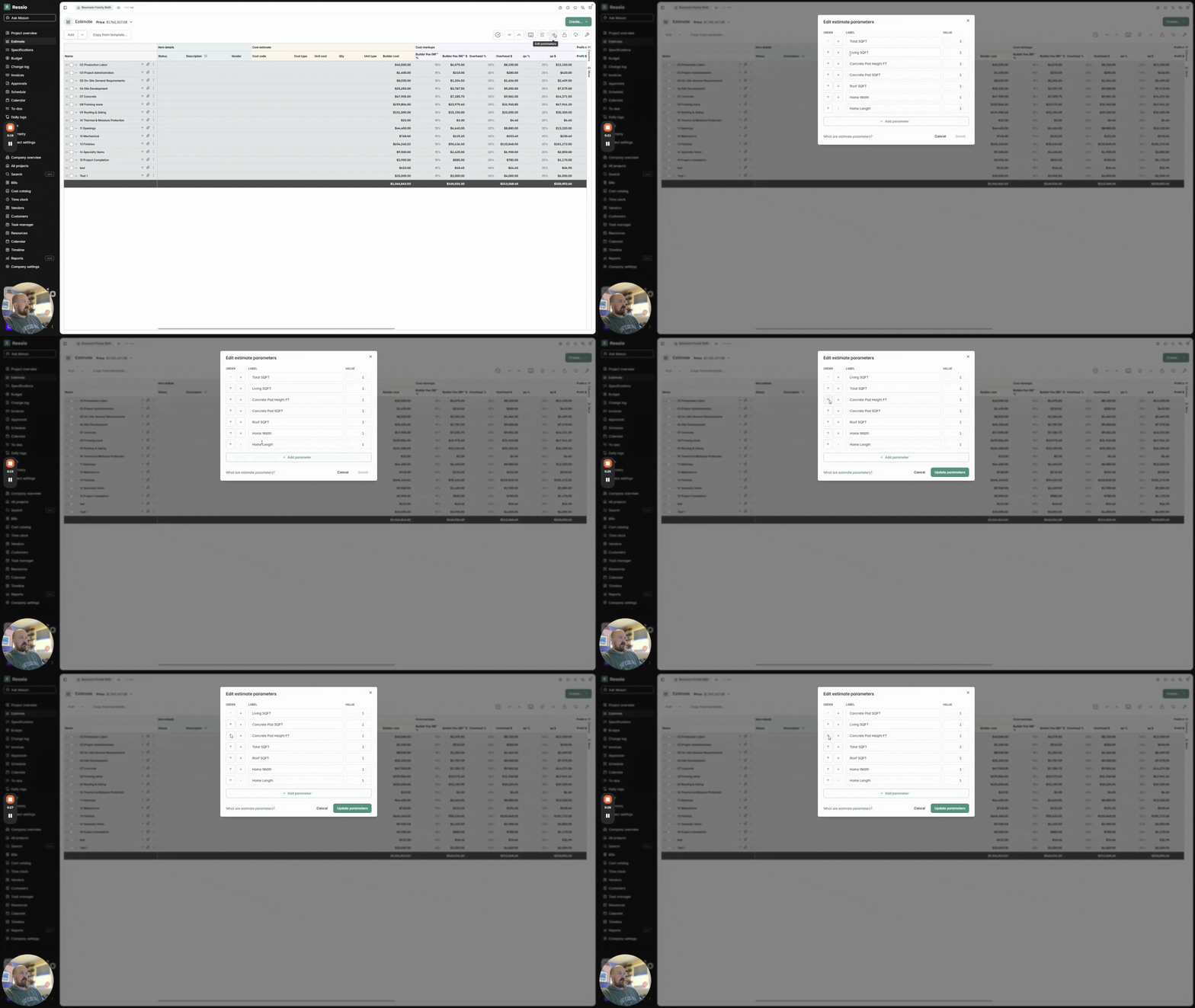
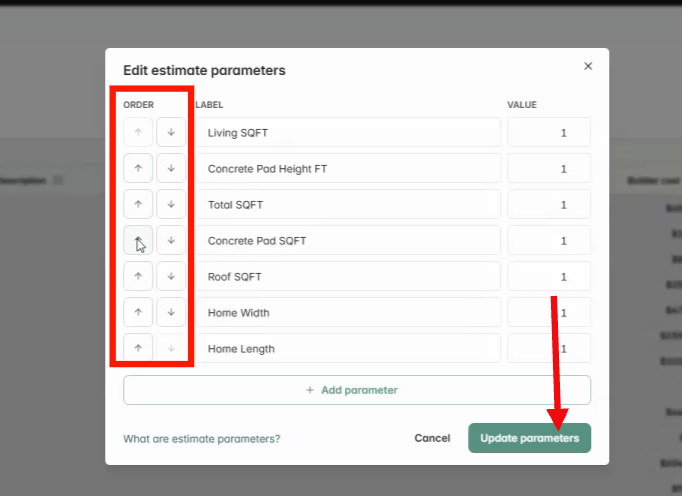
After you finish sorting, don't forget to click 'Update parameters'.
If you have any questions or need further assistance, contact our support team at support@ressiosoftware.com. We're here to help!